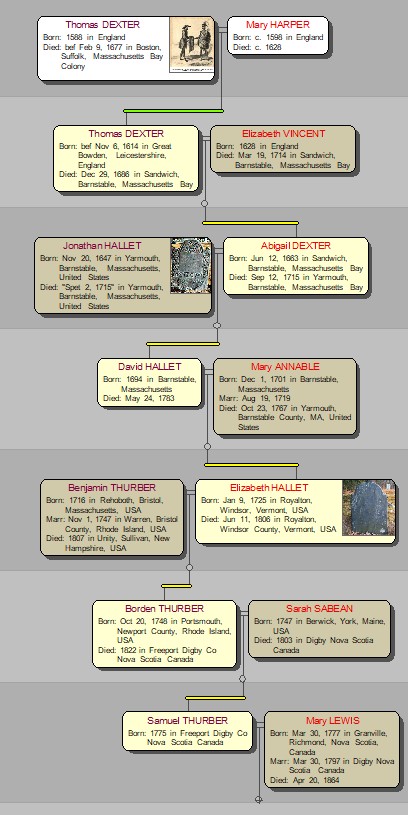
Thomas DEXTER is great (x10) grandfather of Wendy Lee THURBER
Excerpt from “Journey of Roots
Born around 1588, Thomas’s roots were traced to Great Bowden, Leicestershire, England, where his life began. There, he married Mary Harper on January 30, 1613. Their family moved to New England in the late 1620s or early 1630s. Their decision to leave England for the New World was significant, and it marked the beginning of a new chapter in their lives.
Although Thomas traveled to New England with his wife and four children, records indicate that his wife did not survive the journey. Her fate remains a mystery, as her name does not appear in any New England records, nor is there any record of her burial in Great Bowden.
Thomas and his family’s arrival in New England took place in 1630, a period when the region was still being shaped by early colonists. They settled in Lynn, Essex, Massachusetts, where they established their new life.
In Lynn, Thomas embarked on a path of entrepreneurship and community service. He earned the nickname “Farmer Dexter” as he established himself as a hardworking and enterprising settler. His farm was located on the west side of the Saugus River, a place that would later become known for the Saugus Iron Works.
In 1631, Thomas became a freeman, a significant milestone that granted him the right to participate in the colony’s governance. However, this newfound status was short-lived. Just two years later, in 1633, he was disfranchised and fined £10 for speaking out against the colonial government. This incident, along with various disputes with neighbors and townspeople, hinted at a contentious nature within the community.
One notable incident in 1631 involved a quarrel with Mr. Endicott, who would later become the governor of Massachusetts Bay Colony. This dispute led to Mr. Dexter being struck by the Salem magistrate and subsequently filing a complaint in the Boston court. The jury awarded him £10 in the verdict.
The year 1633 brought a more significant change in Thomas Dexter’s life when he was ordered by the court to be set in the bilboes, disfranchised, and fined £10. However, he remained undeterred by these challenges.
Despite the adversities, Thomas Dexter’s industrious nature shone through. In 1633, he constructed a bridge over the Saugus River and a mill. His ambitious efforts extended to the establishment of the Saugus Iron Works, where he served as a general manager and investor. In honor of his contributions, a plaque at the modern-day reconstruction of the Saugus Iron Works in Massachusetts commemorates his legacy.
In 1637, Thomas Dexter and nine others received a grant for the township of Sandwich in Barnstable, Massachusetts, from the Plymouth Court. Thomas contributed to the town’s development by building the first grist mill.
Yet, his wanderlust was still strong, leading him to purchase two farms in Barnstable, one adjacent to the mill stream and the other on the northeastern side of Scorton Hill.
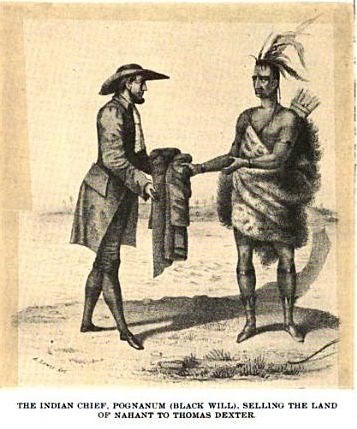
A defining moment in his life was the purchase of Nahant, which he acquired from the Indian chief Pognanum (Black Will) in exchange for a “suit of good clothes.” This acquisition would lead to years of legal disputes with other inhabitants over the land’s ownership. These disputes persisted for over thirty-eight years, eventually culminating in his defeat.

 Books by Michael Klauke
Leave a comment