Holy shit, what a trip.
We were about three hours into the drive north, cruising up I-75 and feeling good. It was a beautiful day, Superbowl Sunday to be precise. The weather had turned warm again and all the stars were aligned. The truck was steady, the RV was tracking straight, and we were even talking about skipping our planned stop in Georgia and just pushing all the way home.
That was when it happened.
Bang!
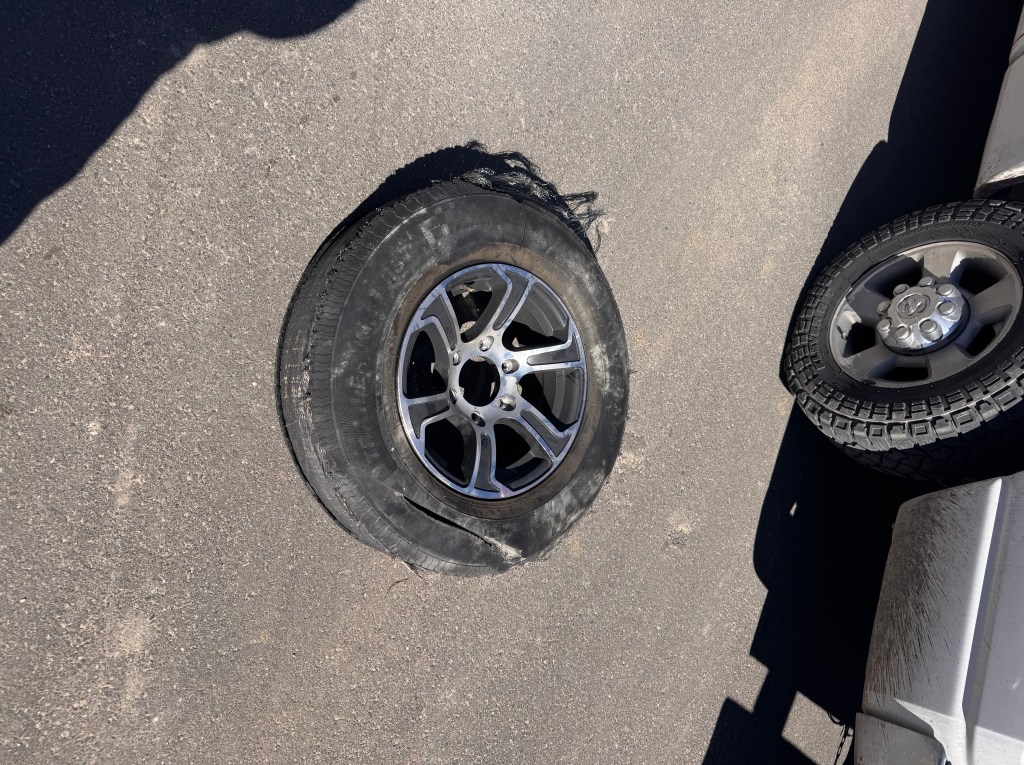
The driver’s side rear tire on the RV exploded without warning. I was in the middle lane with the cruise control set at seventy-two, which suddenly felt ambitious. The trailer started to lean and wag like it was trying to throw us off. I let off the gas immediately and eased the whole rig toward the shoulder, heart pounding but hands steady enough to keep it together.
We made it over safely.
We had a spare tire and I had tools, but I did not have a jack that could safely lift the trailer. That felt like a pretty big oversight in hindsight.
Before leaving, we had purchased Good Sam roadside assistance, so I called them and asked for help. They sent a polite confirmation message saying assistance was on the way. This would later prove to be a lie.
While we waited, Wendy suggested calling the Florida Highway Patrol just to let them know we were broken down. We did, and within minutes a highway service truck pulled up behind us. A young guy got out, polite, calm, and ready to work. His English was limited, but his confidence was not.
I pulled the spare tire off the back of the trailer and immediately noticed it had a noticeable bulge on the top of the tire. It turns out the steel belt had separated from the tire. These tires were just three years old.
Crap.
The service guy took one look at it and confirmed what I already knew. It was not great, but it was all we had.
Then he showed me a trick I will never forget.
He placed a solid block of wood in front of the good tire on the same axle. Two axles, four tires total. He told me to slowly pull the trailer forward. As the good tire rolled up onto the block, it lifted the blown tire just off the ground. Brilliant. He barely had to jack the trailer at all. We swapped the shredded tire for the questionable spare and got the rig rolling again.
That was when I noticed the real damage.
When the tire blew, it took out siding, trim, insulation, and gas lines underneath the trailer. The bottom of the RV looked like it had been attacked by a weed whacker powered by anger.
I thanked the young man profusely and tried to tip him. He refused. Just nodded, packed up, and drove off.
We limped to the very next exit where there was a Firestone dealer, only to discover it was Sunday and the place was closed. Of course it was. We called a mobile tire service and waited in the parking lot of the Firestone for an hour and a half. Eventually the guy showed up with two new tires. He replaced the blown tire and the damaged spare, and we were back on the road.
Good Sam never sent anyone. We canceled the service request and mentally added it to the growing list of lessons.
We made it into Georgia and were starting to relax again when, at around four in the afternoon, it happened a second time!
Bang.
This time it was the passenger side rear tire. Same drill. Trim flying, trailer leaning, adrenaline spiking. I was furious.
We called Good Sam again, because apparently we had learned nothing. They said they would try to find help. We also called Georgia Highway Services, who also said they would try.
It was now Superbowl Sunday, around five in the evening, and roadside help was becoming a scarce resource.
We started discussing contingency plans. Drop the trailer. Drive to Walmart. Buy a jack capable of lifting the behemoth. I gave each service about twenty minutes before committing to that plan.
Fortunately, a Georgia highway service truck showed up before the clock ran out. The guy was helpful enough, though not nearly as slick as the Florida hero with the wood block trick. He jacked the trailer, I wrestled the tire off, and we got the second replacement mounted.
By the time we reached the campground it was around seven in the evening and we were completely spent.
The blown tire had ripped the gas lines from the bottom of the RV, so the stove was dead as was the heat for the trailer. No hot meal. No easy dinner. Instead, we lit a fire, poured a couple of drinks, and cooked hot dogs over the open flames like exhausted pioneers.
It was a rough day, but somehow that fire, those burned weenies, and the fact that we were still upright made it feel like a win.
It was February in Georgia, which means the days can fool you but the nights still bite. Once the sun drops, that damp Southern cold settles in and crawls right through thin RV walls.
Before the trip, Wendy had read about small ceramic heaters that could take the chill off a camper without sounding like a jet engine. The main HVAC unit worked fine, but it cycled loudly and felt excessive when you just needed to nudge the temperature up a few degrees. So we bought a couple of the ceramic units and packed them along.
When we were unwinterizing the RV earlier in the trip, we had plugged them in to help keep things from freezing. At the time it felt like overkill.
Now, sitting in Georgia after a day of blown tires and roadside repairs, those little heaters were heroes. They hummed quietly in the background, taking the edge off the cold without shaking the whole trailer every time they kicked on. It was a small thing, but after a day like that, small comforts feel enormous.
They were lifesavers.
Lesson #3 – Have a plan for alternate heat. The ceramic heaters were dismissed as poor performing on the reviews, but they kept us warm when we had no gas.
As soon as we were settled, I started researching the tires. Our camper weighed about 7600 pounds unloaded. Add four or five hundred pounds of gear and we were close to 8000 lbs.
After blowing two tires in one day, I started paying attention to numbers I should have understood before we ever left Kentucky.
Tires are not just round pieces of rubber. They have weight ratings with consequences.
Our trailer is a double axle setup. That means four tires are carrying the entire load. Each tire had a load index rating of 117.
We had Trailer King Tires on the trailer. They came with the unit and they looked fine. Given the unit was a 2023, the tires were about 3 years old.
The Trailer King RST 225/75R15 (117/112M) is a Load Range E (10-ply) radial trailer tire with a maximum load capacity of 2,860 lbs at 80 psi. It has an “M” speed rating, meaning it is rated for speeds up to 81 mph (130 km/h).
Which means we had a max load rating of 11,440 lbs.
Using good engineering practice and only loading to 80%, the max load in the trailer should be 9152 lbs.
So let’s run the numbers honestly.
If the trailer weighs 7,600 pounds empty and we add 1,000 pounds of gear, which is not unrealistic since my wife does not travel light, plus 500 pounds of fresh water in the tank, we are sitting at 9,100 pounds rolling down the highway.
Now compare that to the functional tire capacity with a safety margin, which we estimated at roughly 9,100 pounds.
That is not comfortable math.
Yes, the axles might technically be rated for 10,400 pounds. Yes, the raw tire math might suggest 11,332 pounds of total capacity. But once you apply a reasonable safety buffer and factor in highway speeds, heat buildup, and imperfect inflation, 9,100 pounds starts feeling like we are working on Vegas odds.
Water alone is heavier than most people think. At roughly 8.3 pounds per gallon, a full tank adds up fast. It is easy to forget you are hauling half a ton of liquid every time you decide to travel full.
At 9,100 pounds, we were not technically overloaded. But we were close enough to the margin that two blowouts in one day stopped feeling like random bad luck and started looking more like a warning.
For me, that is too close to the limit.
The lesson is simple. Just because you are under the rated maximum does not mean you are operating safely. A comfortable buffer is not wasted capacity. It is insurance against heat, speed, road debris, and human error.
Also, the road side tire service guy told us the tires are only good for about 4 years and after that they should be changed. The RV trailer tires sit more than the roll, so they are subject to dry rot. He also told me I had cheap tires and the ones he replaced them with were much better.
I did not see any difference in the rating between what he sold me and what was originally on the trailer.
The next day after everything had settled down, I went to a new tire store and bought for new tires for the trailer.
Upgrading to 14-ply (Load Range G) tires in the same size (ST225/75R15) increases your single tire weight rating from 2,833 lbs to approximately 3,197–3,420 lbs.
Also, did you know the rims have a pressure rating as well? I didn’t. Make sure if you upgrade your tires, your rims are designed for the higher pressure tires.

 Books by Michael Klauke
Leave a comment